
City Council Workshop, Aug 5, 2026

AI Assisted: Summary created with the help of artificial intelligence.
Disclaimer: These are unofficial notes. Refer to the City of Dover for the formal record.
Summary
The Dover City Council Workshop on August 5, 2026, provided informational presentations on the Police Department’s outreach and prevention programming and the updated Local Emergency Operations Plan and Continuity of Operations Plan.
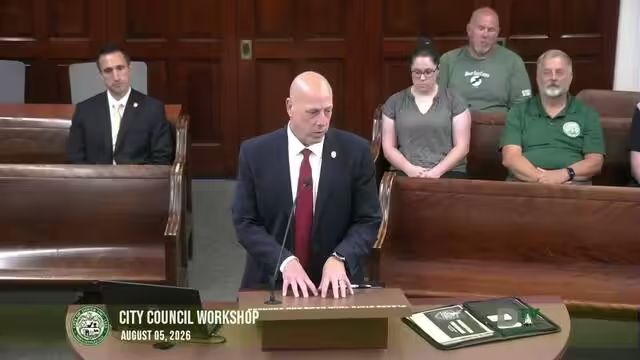
Police Department Outreach and Prevention Programming
In Brief
The Dover Police Department presented its comprehensive, evidence-based youth substance abuse prevention programs, which extend far beyond the traditional DARE curriculum and are funded through a mix of federal, state, and private grants.
Key Points
- The prevention unit began in earnest in 1992 with a community coalition and has expanded to include DARE, Dover Youth to Youth, the Dover Teen Center, the Juvenile Diversion Program, and EPIC (Alternative Suspension Program).
- Youth Risk Behavior Survey data shows 30-day underage drinking among high school students dropped from 47% to 23%, with nicotine use also significantly decreased; 2023 is the most recent data year.
- Dover Youth to Youth is an evidence-based program (level 3, the highest state designation) with nearly 50 youth members; has helped pass 4 state laws and 6 city ordinances
- The Teen Center serves approximately 4,300 visits annually, staffed by a director and college interns, primarily from UNH, with some criminal justice majors.
- Current funding sources include CDC, SAMHSA, BDAS, and Wentworth-Douglass Hospital; the Partnership for Success grant expires next year with a smaller replacement funding level
- The department is in the final hiring process for one additional prevention programmer position.
Council Inquiry
- Councilors asked about the gap in school-based programming between fifth grade and eleventh grade, noting the school removed a seventh grade program.
- A councilor asked how at-risk youth navigate access to resources like the Teen Center; the Chief explained multi-agency wraparound services involving DCYF, county attorney, and forensic interviews.
- Councilors inquired about the selection process for targeted programs and confirmed the Teen Center is open to any youth.
- Questions were raised about legislative advocacy efforts, including work on Kratom, vaping products, and alcohol labeling with Senator Watters.
Emergency Operations Plan (LEOP) and Continuity of Operations Plan (COOP)
In Brief
Dover’s Fire Chief presented two rewritten emergency management plans that establish frameworks for maintaining essential city functions during disruptions and coordinating city-wide unified emergency response.
Key Points
- The COOP plan is an internal document ensuring essential city functions continue during disruptions, with a 12-hour activation window and planning for 30 days of relocation capability.
- The LEOP plan is a framework for city-wide unified emergency response when incidents exceed individual department capacity, with four EOC activation levels: monitoring, partial, full, and sustained.
- A new Annex B addresses community coordination, recognizing the need for improved public communication and listening to community needs during emergencies; the Deputy City Manager serves as liaison.
- Both plans were fully rewritten from the 2018 versions, involving all 17 city departments with individual annexes for each.
- Funding came from CARES Act money from COVID distribution, aimed at increasing community involvement in emergency response.
- Tabletop training exercises for both plans are scheduled for fall 2026 following adoption.
- The LEOP will be presented for adoption via resolution at the next council meeting; the plans were written by PR Strategies with support from Next Wave and HazardBrock.
- An existing mutual aid agreement covers operational responses, though no formal facility-sharing agreements exist between communities.
Council Inquiry
- A councilor asked which plan activates during a cyber attack on water infrastructure, referencing recent attacks on 12 states; the Chief clarified both plans can activate simultaneously, with COOP for localized issues and LEOP for city-wide incidents.
- Councilors asked about training opportunities for both plans, with the Chief confirming tabletop exercises and the potential use of current news stories as scenarios.
- Questions clarified that the Emergency Management Director serves as both COOP Director and EOC activation authority, working with the City Manager.
- A councilor asked about shelter operations history, noting the warming center and recent cooling center usage at the McConnell Center during the early July heat wave.
Financial/Strategic Outlook
The Partnership for Success grant expires next year with a smaller refunding amount, creating a projected deficit in prevention programming funding; Wentworth-Douglass Hospital and BDAS grants require annual or biennial applications with decisions typically arriving in March. The LEOP adoption resolution will come before the Council at the next regular meeting, with tabletop training for department heads planned for fall 2026 after adoption.