
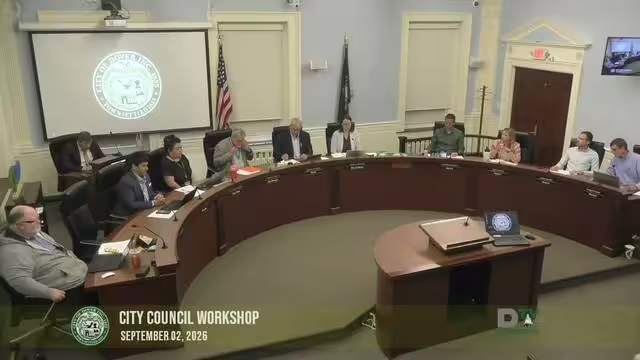
City Council Workshop, Sep 2, 2026

AI Assisted: Summary created with the help of artificial intelligence.
Disclaimer: These are unofficial notes. Refer to the City of Dover for the formal record.
Summary
The City Council convened to review the transition to an automated solid waste collection system, assess recent milfoil removal efforts, and evaluate water infrastructure and supply plans.
Solid Waste Collection Transition
Key Points
- Staff and presenters detailed a transition to an automated toter system with a contracted waste management vendor, slated to begin July 1st of next year.
- The contract covers 7,800 trash and 7,800 recycling toters.
- The city will incur a $7 monthly charge for every unit over the 7,800 baseline and receive a credit if the number is lower.
- Toters will remain with the property address.
- The program limits eligibility to properties with three units or fewer.
- Residents must use commercial bags, bag and tie their waste, and place it entirely within the toter so the lid closes.
- Private haulers operating in the city will also be required to use containers with lids to prevent trash from blowing away.
- After a three-month trial period, citizens may resize their toter for a $75 fee, pending city approval.
- Bulky waste collection will shift to a $25 per item fee.
Council Inquiry & Responses
- Scheduling Bulky Waste: Councilors asked how residents will schedule bulky waste pickups. Presenters explained residents will contact the vendor directly via phone or online, pay the vendor, and the pickup will occur twice a month on standard trash days.
- Damaged Toters: A Councilor asked who pays when a toter breaks from repeated lifting by the truck. Toters damages by wear and tear will be replaced free of charge. Where damage is cause by resident abuse, it will be the financial responsibility of the property owner.
- Public Education: Councilors inquired about the communication plan. Staff noted that $20,000 has been set aside in the budget for educational materials, mailings, and media outreach.
- Multi-Unit Properties: Councilors asked for clarification on the three-unit rule for multi-structure properties. Presenters clarified that eligibility is based on a single taxable parcel; a property with seven residential units across multiple structures would not qualify.
- Ineligible Properties: Councilors asked what residents of properties with more than three units should expect. Staff stated they will receive notices, ideally in their water bills, informing them they are no longer eligible and must make their own private trash arrangements.
- Accessibility Concerns: Councilors asked how seniors or individuals with physical limitations would manage the 64-gallon toters, particularly in the snow. Presenters stated the toters have built-in wheels for mobility, and city staff will work with residents who require accommodations, such as a smaller 35-gallon toter.
Milfoil Removal Efforts
Key Points
- A $149,000 contract funded Diver-Assisted Suction Harvest (DASH) operations that mobilized on May 27.
- Over 30 days of diving, crews removed approximately 61,000 gallons or 300 cubic yards of plant biomass.
- State environmental officials estimate that up to 30 acres of the infestation were cleared.
- To prevent re-rooting from fragmented debris, city staff deployed a skiff and used pitchforks to manually extract floating plant masses.
- City staff prepared a $110,000 grant application, due in September, to fund a second year of diving efforts to avoid the use of herbicides.
Council Inquiry & Responses
- Volume Expectations: Councilors asked if the amount of milfoil removed met expectations. Staff stated the state was impressed with the volume removed, though there were concerns about fragmentation.
- Future Maintenance: Councilors asked if the new grant amount would establish a normal year-to-year maintenance baseline. Staff noted that while complete eradication becomes harder as the plant density decreases, investing in another year of DASH efforts is necessary to avoid using herbicides.
Water Infrastructure And Supply
In Brief
An overview of the city’s water infrastructure master plan, detailing supply production, water main replacements, and treatment facility upgrades to ensure adequate and clean water distribution.
Key Points
- The city maintains 211 miles of water pipe and 11 wells, producing roughly 2 million gallons of water daily, which can peak at nearly 4 million gallons during the summer.
- The city has completed about one mile of large transmission main replacement per year over the last decade.
- Recent infrastructure completions include the Garrison Hill tank renovation, the addition of the Smith elevated tank, and the Pudding Hill treatment facility, which handles PFAS and other contaminants.
- A new water treatment project is planned for the French Cross Road area.
- The city received a sustainability award from the state for pioneering work in managing groundwater resources.
Council Inquiry & Responses
- Production vs. Population: A Councilor asked why water production has decreased between 2015 and 2025 despite population growth. Presenters attributed the drop to aggressive leak detection programs and the increased use of water conservation plumbing fixtures in new and renovated homes.
- Cybersecurity: Councilors inquired about the city’s vulnerability to cyber attacks on its water infrastructure. Staff explained that a federal audit confirmed the internal network is completely isolated from outside networks and does not feature a network interface, leaving it highly protected.
- Infrastructure Lifespan: A Councilor asked about the expected lifespan of the newly installed water mains. Staff explained that the city uses ductile iron pipes wrapped in a protective plastic liner to prevent corrosion, aiming for a lifespan of at least 100 years.
- System Vulnerabilities: Councilors asked what the most significant operational vulnerability is currently. Staff emphasized that severe staffing shortages — currently featuring 12 vacancies and an inability to compete with private sector compensation — place immense strain on daily operations.
Financial/Strategic Outlook
- The solid waste vendor contract spans five years with an option to renew for another five years; if the city exits the contract before ten years, it must purchase the toters at an expense exceeding half a million dollars.
- Current solid waste transition costs are accommodated in the budget, but potential subsidies for bulky waste fees and inflationary increases will be reviewed in the upcoming budget presentation.
- The capital improvements plan will continue to fund strategic water main replacements and redundancy projects across the city.