
What the Headlines About Dover’s Property Taxes Don’t Tell You

The Foster’s Daily Democrat article, “Dover taxes for $500K home far higher than Portsmouth: Seacoast towns compared,” draws on a New Hampshire Fiscal Policy Institute report, comparing property tax bills across Seacoast communities using a single benchmark: a home assessed at $500,000. Under that lens, Dover’s tax bill of $9,840 looks steep next to Portsmouth’s $5,755, Newington’s $3,940, or New Castle’s $2,865.
If using a $500,000 residential property value and current Seacoast tax rates, the numbers presented in the article are technically accurate — in the same way that you’re getting ripped off for paying $25,000 for a Honda Civic when other people are driving Bentley Continentals, or my personal favorite, the Pagani Huayra. But they can lead readers to the wrong conclusion. With credit to the author of the Foster’s article, he says as much. Unfortunately, the article is paywalled, and its title doesn’t do readers any favors.
Ian Lenahan, writing for Foster’s Daily Democrat, “Dover taxes for $500K home far higher than Portsmouth: Seacoast towns compared”:
New Castle — an island town of less than 1 square mile of land, where homes regularly sell for seven figures, not $500,000 — boasts the lowest property tax rate in the Seacoast at $5.73 per $1,000 of assessed property value. Lee, a town of about 4,600 residents, has the highest tax rate at $27.61 per $1,000.
That paragraph has to do a lot of heavy lifting. When you assume all Seacoast homes are $500,000, it makes Dover look pretty bad.
A $500,000 Home Means Something Very Different in Each Town
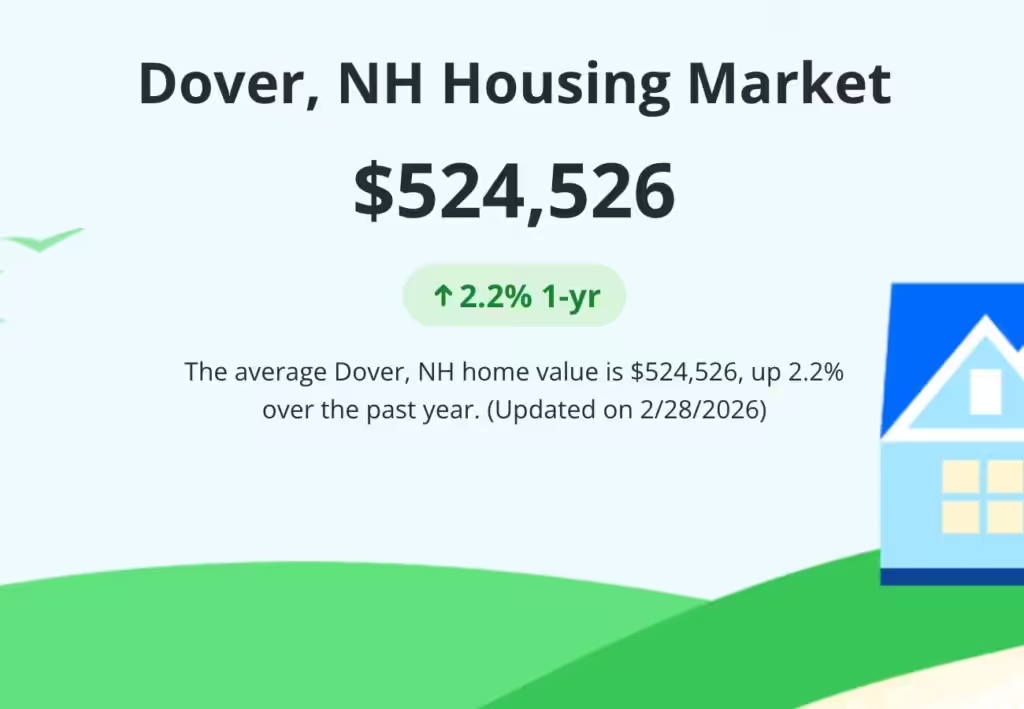
The core challenge with the title of the Foster’s article is that readers might assume that $500,000 as a typical home value everywhere. It isn’t. According to Zillow, the average home price in Dover is around $525,000. The average price of a home in New Castle is $2.36 million. As of right now, the lowest priced home for sale in New Castle is $852,000 at 1,300 square feet. Yes, New Castle residents are paying a lower tax rate than Dover. But New Castle property owners aren’t being taxed on $500,000 properties either.
As I explained in a previous article, this is how the amount you pay property taxes is calculated:
(Assessed Value / $1,000) × Tax Rate = Tax Bill
Dover
Let’s look at what the average homeowner in Dover is actually paying in property taxes.
($524,000 / $1,000) x $19.68 = $10,312
New Castle
What does the average homeowner in New Castle actually pay in taxes? After all, its tax rate is much lower. It follows that the average homeowner in New Castle must be paying less. But, they’re not.
($2,360,000 / $1,000) x $5.73 = $13,523
Portsmouth
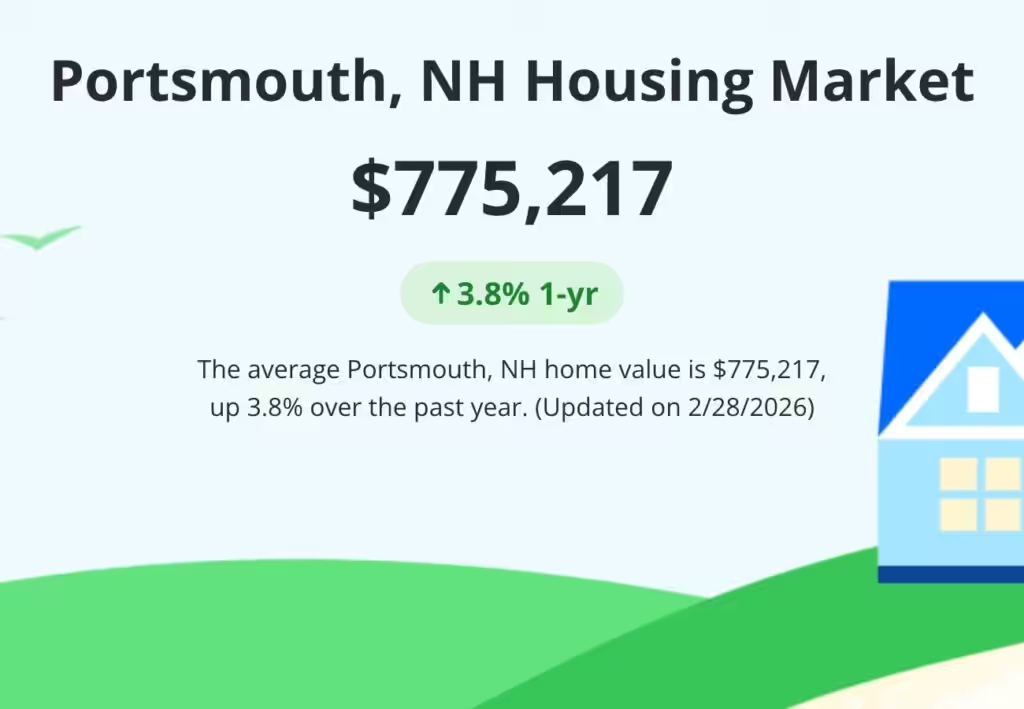
The Foster’s article specifically compares Dover to Portsmouth in its title. Portsmouth has a lower tax rate than Dover. That’s accurate, so what is the average Portsmouth homeowner paying in property taxes?
($775,000 / $1,000) x $11.51 = $8,920
Here, you’ll see that we get to a more meaningful comparison. Even though the average property value in Portsmouth is a good deal higher than Dover, Portsmouth homeowners appear to be getting a better value for their dollar. It’s more economically efficient to own a property in Portsmouth than it is in Dover. I hope you believe that by my even writing this, I am intending to be truthful in my writing and explanation.
Barrington
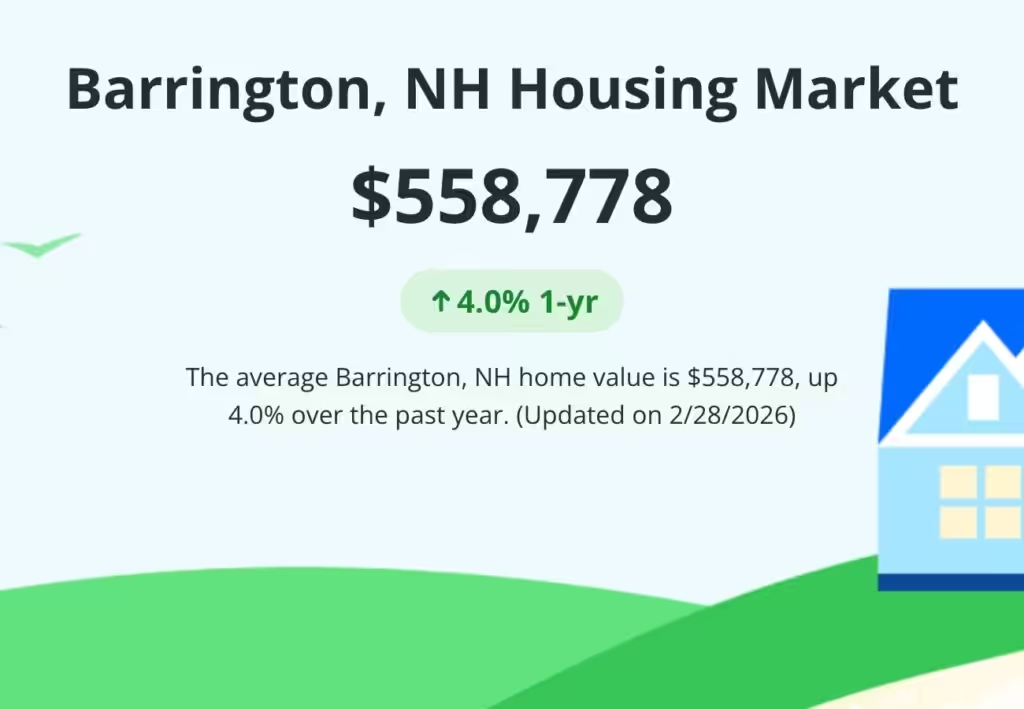
Barrington’s tax rate is close to that of Dover’s, and its property values are similar. As expected, with average property values that are slightly higher than Dover’s and a tax rate that is also slightly higher, homeowners are also paying slightly more in property taxes than Dover. I promise that I am not grading on a curve here.
($559,000 / $1,000) x $19.56 = $10.934
Newington
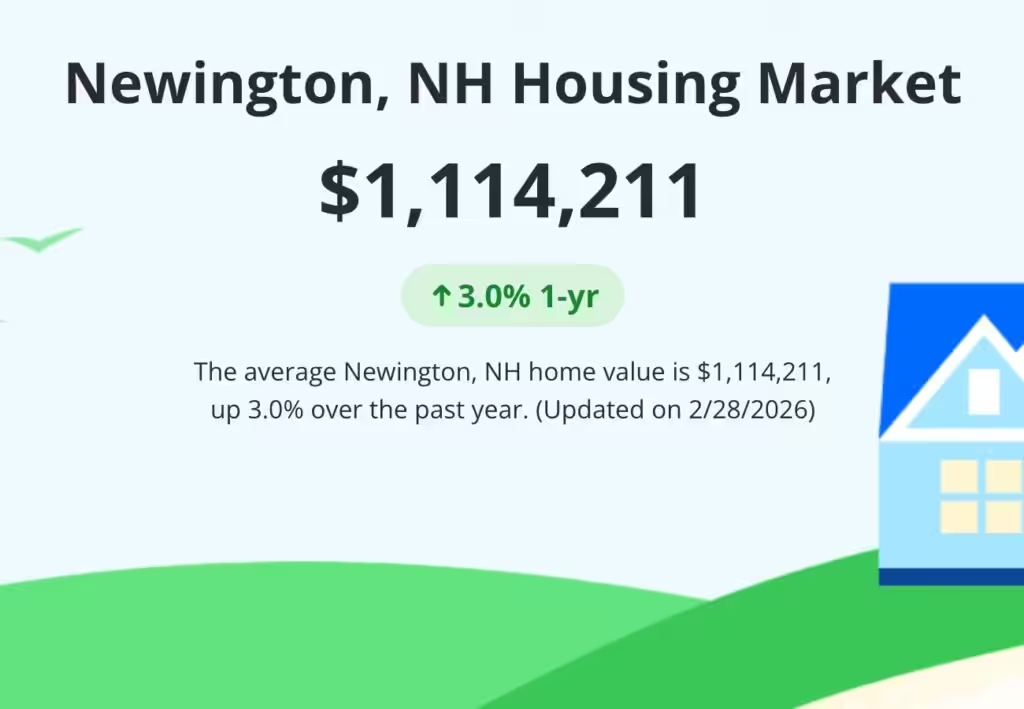
The average value of a home in Newington is $339,000 more than the average value of a home in Portsmouth and more than twice the value of the average Dover home. Yet, the average property owner in Newington is paying less in property taxes than residents in Portsmouth and Dover. Are public officials in Newington just better at this? What’s going on?
($1,114,000 / $1,000) x $7.88 = $8,778
What Does This Tell Us?
Average property values vary widely across Seacoast communities. Using $500,000 as the baseline value of a home doesn’t tell you what the average person is paying for property taxes in their given community. It doesn’t actually provide more information than the rate alone does. It’s as if to say, “If you’re living in this community, you’re paying X-rate per $1,000 of your property’s value.” Depending on where you choose to live, the average cost of a home could be anywhere between $389,000 and $2.37 million. That said, if you want the lowest property tax rate on the Seacoast — not the lowest tax bill — New Castle is the place to be.
The following scatter chart shows average property values for Seacoast communities on the X-axis and the tax rate on the Y-axis. Hover on a given dot to see where Dover and other communities place.
You’ll notice that several Seacoast communities are clustered together. For steep drops in the tax rate, you need to look at communities with high average property values: Newington, Rye, and New Castle.
Our Taxes Are Still High. What Gives?
Education Is a Cost Driver
Dover operates a full K–12 district: three elementary schools, a middle school, a high school, and a career technical center serving roughly 3,700 students. That requires buildings, teachers, administrators, support staff, maintenance, and transportation. Small wealthy communities like New Castle and Newington don’t carry those costs. New Castle runs a single elementary school with about 27 students. Newington’s has about 50. For secondary education, both towns pay tuition to send students to neighboring districts. That’s far cheaper than building and staffing their own schools. When your entire student population could fit in a couple of classrooms, the math is simple.
I’ll go ahead and ask the next question myself: “Then, why does Dover have schools? Why don’t we send our students somewhere else?” Okay, those were two questions with one answer. After a community’s student population reaches a certain size, it makes financial sense to build a school, hire educators, and assume the infrastructure costs. Frequently, communities serve pre-K and elementary locally and send high school kids out of district. That is generally because high schools require massive capital investments that pre-K and elementary schools do not.
Commercial and Tourism Offset Residential Property Taxes
Every dollar of tax revenue that comes from a hotel, a restaurant, or a retail corridor is a dollar that doesn’t come from someone’s home. Said another way, commercial property taxes subsidize residential taxpayers. Commercial property owners pay for, but do not use, public education.
Newington is the most dramatic example. Its tax base is almost entirely commercial. The Woodbury Avenue corridor, the Crossings, and the former Fox Run Mall site (now being redeveloped into the $500 million Seacoast Landing project) generate enormous revenue shared among fewer than 1,000 residents. Portsmouth benefits from a similar dynamic on a different scale: a thriving downtown, a tourism economy, and a hotel industry that collectively broaden the tax base beyond what homeowners contribute. Dover has commercial activity, but it is fundamentally a residential city. Our homeowners carry the majority of the tax burden because there simply isn’t a comparable commercial base to share the load.
The following chart is sorted by population from left to right and shows the total amount of taxable property value per Seacoast municipality. Newington has the smallest population at 826 residents. Yet, it has more taxable property value than the next eight municipalities. Beginning with Greenland, communities start to have more value than Newington. Greenland’s population is 4,134.
All the way to the right, Dover has the highest population on the Seacoast. Yet, despite that, Portsmouth has more than $3.65 billion in taxable property value — the highest on the Seacoast — compared to Dover’s. Both Newington and Portsmouth residents benefit from commercial property providing relief to residential property tax bills.
Geography and Infrastructure
Dover covers roughly 27 square miles and serves about 34,000 residents. That means miles of roads, water mains, sewer lines, sidewalks, stormwater systems, and the personnel and equipment to maintain all of it. We operate a public water system and a wastewater treatment facility. New Castle is less than one square mile with no public water or sewer. Newington is about 8 square miles but has fewer than 1,000 residents and limited residential infrastructure needs. One cannot compare the cost of running a city to the cost of running a small town and draw any meaningful conclusion from the tax rate alone.
The chart above plots population density against taxable value per square mile. Bubble size reflects total taxable property value, and color reflects average home value. Portsmouth has the largest bubble on the chart — over $10 billion in total taxable value — and it generates over $645 million per square mile. Dover’s bubble is the second largest at $6.4 billion, but that value is spread across 27 square miles, producing about $241 million per mile. Meanwhile, New Castle packs over $1 billion in taxable value into less than a single square mile, pushing it to the top of the chart. The pattern is clear: communities with high property values, commercial density, or both generate far more revenue per mile — and can fund services at lower tax rates.
Taxable Property Value per Resident
There are lots of ways to look at data. A useful number to look at is: taxable property value per resident. Take the total taxable property value in a community and divide it by the number of people who live there. Newington has $1.54 million per resident with its small population and large commercial base. New Castle has $1.07 million. Portsmouth has $432,000. Dover has $190,000. That gap is why our tax rate is higher. It’s not because Dover is spending recklessly, but because we’re funding a full-service city with a fraction of the fiscal capacity per person.
Where Does this Leave Dover?
The New Hampshire Fiscal Policy Institute’s report makes a point that’s bigger than any town-by-town comparison. New Hampshire relies on local property taxes more than any other state in the country. About 63% of all state and local tax revenue comes from property taxes. Local governments have almost no other tax revenue options, and the state provides less aid to municipalities than nearly every other state in the nation. That’s the structural constraint every community in New Hampshire operates within, and it hits hardest in cities like Dover. We provide a full range of municipal services and have a large residential population that’s spread across a large geographic area.
Dover is not Portsmouth. We’re not sitting right off I-95 with a downtown full of hotels and a tourism economy that generates millions in commercial tax revenue. We’re not Newington, where an almost entirely commercial tax base subsidizes fewer than 1,000 residents. And we couldn’t become either of those places even if we wanted to. Dover is a residential city, and most of our real estate is already developed. Because Dover’s population is weighted residential — unlike Portsmouth or Newington — nearly all of our costs fall directly on homeowners.
This does not mean we’re stuck. The numbers in this post point toward what Dover is already working to do: increase our value per square mile without pushing the cost of services higher. Mixed-use development is a good example, and Pointe Place is a success story. A building with housing above ground-floor commercial generates more taxable value per acre than a single-family home — and it doesn’t require new roads or new sewer lines. The Liberty Mutual vacancy (Sky Hill development) is exactly this kind of opportunity, along with attracting commercial and light industrial development in the right locations. Every dollar of commercial value added to Dover’s tax base is a dollar of pressure taken off residential homeowners.
None of this happens overnight. But understanding why our tax rate looks the way it does is the first step. The headline said Dover’s taxes on a $500,000 home are far higher than Portsmouth’s. The reality is more complicated than that.
What’s the Key Takeaway?
Over half of our property taxes fund education. While commercial properties utilize utilities and commuters use our roads, businesses do not add students to our school system. This means adding commercial value to Dover increases financial stability for homeowners and renters. It drives up our taxable revenue per resident without proportionally increasing our cost drivers.
This is why smart, mixed-use development is such a powerful tool for a residential city like Dover. By combining ground-floor commercial spaces with upper-level condos and apartments, we create much-needed housing options while maximizing our taxable value per square mile using infrastructure that already exists. It allows us to grow our revenue efficiently to fund the city services we use every day, while providing direct property tax relief to the single-family homeowners who make up the heart of our community.

This article may be republished online or in print under Creative Commons license CC BY-ND 4.0. Please credit the author, Bret Carmichael, and this website — BretCarmichael.us — with a link to the original URL. If you have any questions about this website’s republishing guidelines, feel free to ask.