
GOP Govs Join Trump Pledge Designed to Shield Ratepayers from Data Center Costs
Commentary not part of original article.
Bret's Take
I’m republishing this article because there’s been lots of discussion about data centers in New Hampshire, especially in light of the withdrawn proposal to build a 40-acre data center in Nottingham. The critiques expressed generally fall into two categories: energy consumption and water consumption. Related to water consumption, data centers used to use lots of water, and it’s been reported that they have caused wells to run dry. This has definitely happened.
The water concern has largely been mitigated by newer technology. Older data centers sprayed water on a mesh to cool them down through evaporation — working the same way humans sweat — using around 5 million gallons a day, which was an enormous draw on municipal infrastructure. To give you a frame of reference, Dover pumps about 3 million gallons a day during the summer. New data centers are shifting toward sealed, air-chilled “closed loop” systems. Once they get their initial fill, the fluid is recirculated indefinitely. They use very little water day-to-day in exchange for using more energy.
The answer to energy is… more complicated. An AI data center can have 100,000 GPUs, and each GPU can use between 700 and 1200 watts. That’s a lot. Energy is a scarce resource. When total energy demand spikes, consumer prices spike right along with it. The “Ratepayer Protection Pledge” intends that big tech companies will bring their own energy infrastructure to support their usage. Governor Ayotte did not sign it. That may be because she already signed HB 672 for off-grid energy production in New Hampshire, or for another reason. I don’t believe that’s good or bad that she didn’t sign the pledge, because a pledge is not a legal obligation.
I’ll say this: when the internet displaced lots of jobs, tech companies were able to do so without permission. With the invention of AI, tech companies need permission. They need to build physical infrastructure. That infrastructure is raising consumer energy prices, and it’s tightening component supplies like memory chips because manufacturers are prioritizing high-margin AI hardware over consumer electronics. We’re paying more for phones, laptops, and anything else with compute and memory.
I’m not making an argument for or against data centers in New Hampshire. They have the potential to bring lots of needed property tax revenue to burdened communities across the state. As inferred above, there are certainly reasons for disallowing them. However, negotiating leverage is with New Hampshire. That means, for any community that is considering a data center, they may be able to get a lot of tax base for little in the way of tradeoffs.
Commentary not part of original article.
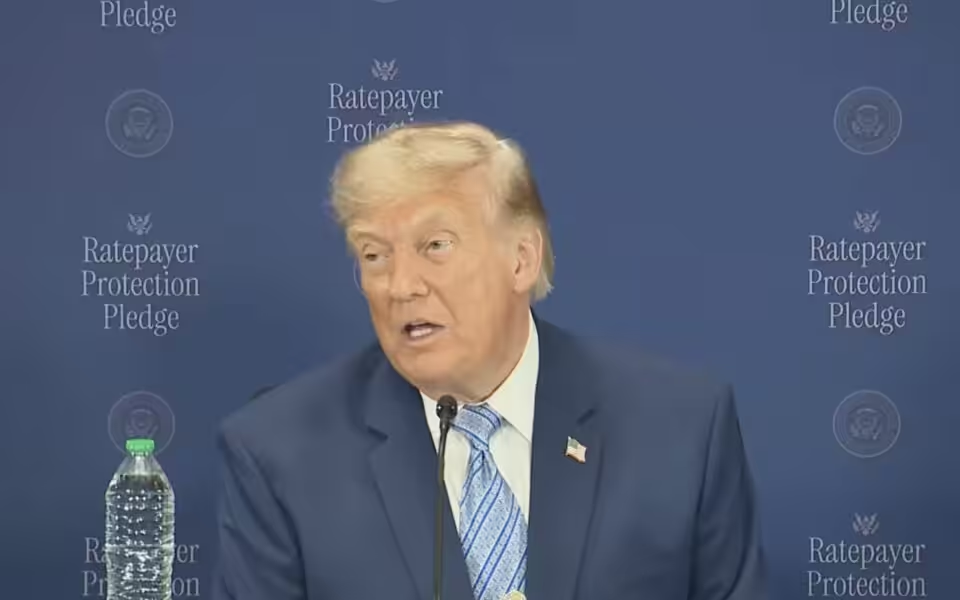
WASHINGTON — President Donald Trump on Thursday announced the addition of Republican governors, legislators, utility services and tech companies into his voluntary pledge aimed at keeping data center construction and operation costs off the shoulders of American consumers.
The Ratepayer Protection Pledge, first signed by the president in March, requires companies that build and use data centers to pay for any new infrastructure upgrades and generation resources that serve them.
Tech giants Google, Microsoft, Meta, Oracle, xAI, OpenAI and Amazon all signed onto the initial pledge. Now, the measure is expanding to include nearly 200 more stakeholders, including multiple governors.
Electric companies and other utilities generally pay for infrastructure upgrades with the revenue that comes from what their customers pay. The agreement aims to shift that cost in communities with new data centers directly to the centers’ companies. According to Trump, the initiative will supply 80% of all the power delivered to American businesses and homes.
“As new data centers go up, all of the electricity bills for American families will actually come down,” Trump said during a roundtable event at the U.S. Environmental Protection Agency on Thursday.
He added that Big Tech companies are “happy” to foot the bill for data centers because it will allow them to continue to function and grow.
“I’ve always said that America’s goal must be to dominate the future, and that includes being the No. 1 superpower in artificial intelligence,” Trump said. “This is how we’ll grow our economy, lower the cost of living, protect American consumers and lead the world in AI and high tech.”
Republican Govs. Jeff Landry of Louisiana, Brian Kemp of Georgia, Jim Pillen of Nebraska and Brad Little of Idaho joined the president at the roundtable to promote their commitment to the pledge. Some governors manage the state utility commissions that set electricity prices.
A total of 23 Republican governors signed the pledge, according to an undated document the White House sent reporters Thursday morning. Only Florida’s Ron DeSantis, New Hampshire’s Kelly Ayotte and Vermont’s Phil Scott declined to sign.
The executives said large power plants are supplying energy for their states without raising consumer costs, and touted partnerships with companies such as Meta.
Landry said his state’s deal with Meta will “save Louisiana $2.6 billion,” helping to strengthen “river liability” and reduce “resiliency costs” for those who live along the Gulf Coast.
In Georgia, Kemp said the pledge will support the operation of nuclear power plants while keeping rates low for local communities.
Contradicting Numbers
The environmental advocacy group Climate Power published a report Thursday that counters the president’s promises of lowered electricity costs for consumers.
According to the organization, prices have spiked 18% on average since Trump took office.
“While Trump stages PR stunts to save his tanking approval rating, Americans are paying the price for his cost-raising agenda,” Climate Power said in the report. “As gas prices hit $4 per gallon again this year thanks to Trump’s war of choice in Iran, Americans in five states faced rate hikes as high as $9 a month.”
The states it listed were Missouri, North Carolina, Connecticut, New Mexico and Oregon.
Beating China
The speakers Thursday, including Trump, governors, U.S. Energy Secretary Chris Wright and Environmental Protection Agency Administrator Lee Zeldin consistently said the pledge could help win an AI race with China.
“Americans are united in their desire to supercharge our economy, to increase our national security by keeping our lead in artificial intelligence over China,” Wright said.
They are also “united in their frustration over the ruinous nearly 30% price rise in electricity across the country during the Biden administration,” he added.
Trump noted China’s authoritarian government does not require environmental impact studies or other permits.
House Bill
Earlier this week, the U.S. House Committee on Energy and Commerce unanimously passed a bill similar to the Ratepayer Protection Pledge to protect Americans from paying higher electricity costs tied to data centers.
Sponsored by Reps. Gabe Evans, a Colorado Republican, and Kathy Castor, a Florida Democrat, the bipartisan Ratepayer Protection Act would require state utility regulators to consider adopting standards for data centers to pay for their own electricity, infrastructure and other developments.
“America must build the energy infrastructure necessary to win the global AI race and outcompete adversaries like Communist China—but hardworking families should never be forced to subsidize that growth through higher electric bills,” Evans, who is the chairman of the Energy and Commerce Subcommittee on Energy, said in a statement Tuesday.
Just before it passed, 52-0, the committee narrowed the scope of the bill to focus specifically on data centers. Language in an earlier draft would have applied to power plants with a maximum electricity demand of 100 megawatts or more, according to Politico.
The Data Center Coalition, an advocacy group representing some of the biggest names in the industry including Amazon, Microsoft and Google, said in a statement Wednesday that it supported the original version of the bill but took issue with the changes.
The changes “single out the data center industry, leaving everyday Americans vulnerable to the costs associated with large load growth from other industries as they continue to expand operations in the U.S,” Josh Levi, the group’s president and CEO, said.
Progressives Push Outright Ban
Some Democratic lawmakers, including as Energy and Commerce ranking member Rep. Frank Pallon of New Jersey, have expressed support for the more restrictive idea of a national data center moratorium.
Rep. Alexandria Ocasio-Cortez of New York and Sen. Bernie Sanders of Vermont have introduced parallel bills in their respective chambers to implement a nationwide AI data center moratorium.
Such legislation would temporarily prohibit the construction of new data centers and the expansion of existing ones in the U.S. until Congress addresses the economic, environmental and safety consequences associated with the facilities. Last week, New York became the first state to impose a ban on AI data centers.
New Hampshire Bulletin is part of States Newsroom, a nonprofit news network supported by grants and a coalition of donors as a 501c(3) public charity. New Hampshire Bulletin maintains editorial independence. Contact Editor Dana Wormald for questions: [email protected].
“GOP Govs Join Trump Pledge Designed to Shield Ratepayers from Data Center Costs” by Amelia Twyman, originally published on New Hampshire Bulletin, is licensed under CC BY-NC-ND 4.0.